LOY LUO

Chronicle Note
Before the Word and After the Word was not conceived as a fixed exhibition, but as a continuously unfolding field of research. Rather than presenting a completed body of work, it evolved over time through the gradual emergence of paintings, installations, spatial adjustments, and conversations. Presented as an exhibition, it created a field where image, writing, space, and viewers entered into dialogue.
Fragments of text became images, questioning the traditional structure of meaning built upon representation. When meaning itself becomes visual or phenomenal, the distance between image and meaning approaches zero—or even moves beyond zero into a state of overlap. Paradoxically, written language, traditionally regarded as a carrier of meaning, may possess an even stronger visual presence than images that directly represent phenomena. As the exhibition continued to unfold, however, the inquiry gradually shifted beyond the visual transformation of writing itself toward the questions that writing inevitably raises: Where does language come from? What remains when language dissolves? In this sense, Before and After were not separate themes, but directions naturally emerging from the same ongoing investigation.
At first, this condition seemed to suggest a possible interruption of dialogue: when signs no longer point toward fixed meanings, where does understanding begin?
Yet the actual encounter within the exhibition revealed another possibility. Rather than becoming silent, the space became increasingly active as the exhibition continued to evolve. Visitors encountered different constellations of works over time and responded through association, memory, curiosity, and conversation. The exhibition suggested that between image and meaning there may exist another path of connection—one not based on fixed interpretation, but generated through encounter.

A continuously unfolding exhibition
Installation View


Exhibition Statement
One of the most well-known statements in Gombrich’s The Story of Art is: “There is no such thing as Art with a capital A, there are only artists.” In the process of creating—when her focus naturally settles into the gestures of marking and writing—Loy Luo has finally discovered a way to respond to Gombrich’s proposition about art and the artist.
In fact, the very moment humans first engaged in artistic creation, Art with a capital A was born. The artist, by contrast, is a product of art history. While working on a new series titled Before the Word, Luo realized that when an artist creates—no matter how practical or decorative the resulting object may seem to others—the seemingly unconscious act of writing or marking becomes a channel between the metaphysical and the physical. Even a so-called “primitive” person, as judged by today’s standards, might have secretly carved marks into a cave wall while asking, perhaps unknowingly: “Who am I? Where did I come from? Where am I going?”
Luo’s mark-making series may appear to continue the innate East Asian cultural impulse toward writing, but her intent reaches far deeper—to a more primal state, to the beginning of being itself. Just as philosophers must reset to a zero-point in order to reconstruct their systems of thought, Luo believes that artists, too, must “zero out” in order to reconnect with their truest inner sensations and build their own languages.
This process of constructing a personal language system has been long and layered: From early practices of hand-copying books to deepen memory and attention; To repeatedly transcribing Buddhist sutras as a self-imposed ritual to quiet anxiety and seek calm; To copying The Book of Songs and The Songs of Chu while living abroad to ease homesickness; To layering and juxtaposing Eastern and Western texts; To inventing pseudo-musical notations, smudging, scratching, and erasing to obscure readability and awaken the visual energy of text; To collage, installation, and the creation of blurred, ambiguous characters—All of these are experiments in a continual search for a new visual and linguistic order.
Her most significant breakthrough is this: From the word, to before the word. It marks not only a return to a pre-linguistic state but also a leap—from culture to philosophy.
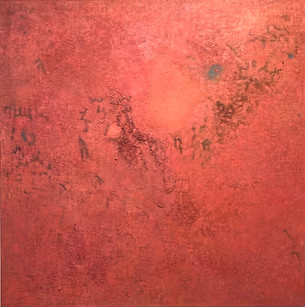
Red Mountain Culture, 48*48",Oil on Canvas, 2023
Selected Works


Video & Media
